Online ordering is temporarily unavailable We are updating our payment-processing system. To place an order, please call 336-306-9393 or send us a secure message in your patient portal. Please do not send payment information or private medical information by email or text. Dismiss
Growing up, two of my favorite movies were the Karate Kid and the Karate Kid II. Why did I love them? It was the peace that the Okinawa Japanese lifestyle brought, as well as their reverence for elders, tradition and taking life at a slower pace. Can we learn something from them? Most definitely!
At daybreak in many Japanese cities, public life is already moving. Older adults walk along neighborhood streets, cycle to nearby destinations, stretch in parks, tend small gardens, or join group calisthenics. The activity is usually ordinary rather than dramatic. It is woven into the start of the day.
These scenes can be inspiring, but they should not become a tidy story about Japan holding a single secret to longevity. Japanese people are not uniformly active, socially connected, thin, or supported by family. Japan also faces loneliness, caregiver strain, a rapidly aging population, and growing numbers of older adults who live alone. Longevity reflects many interacting biological, behavioral, economic, environmental, social, and healthcare factors.
Still, visible patterns in Japanese daily life raise useful questions. What happens when movement remains part of ordinary errands? What changes when communities make it easier for older adults to participate? What if healthy aging is treated as a practice built over decades rather than a rescue mission that begins after independence is already threatened?
The adults walking or exercising at 75 probably did not wake up on that birthday and invent an active life. Their current capacity reflects years of repetition, opportunity, health, work, family demands, illness, and recovery. Some had supportive environments; others had to adapt around limitations. The larger point is that aging does not begin in old age.
Daily movement works like a long conversation between the body and its environment. Walking preserves confidence in walking. Carrying groceries asks the hands, trunk, and legs to keep contributing. Stairs challenge power and balance. Gardening requires reaching, kneeling, gripping, and getting back up. Each task may look too small to count as exercise, yet together they repeatedly ask the body to remain capable.
This does not mean every older adult should push through pain or ignore medical restrictions. It means that removing all effort from daily life can have a cost. Convenience is helpful when it protects safety and energy. When it eliminates nearly every reason to stand, walk, carry, reach, or solve a physical problem, it may also remove the practice that keeps those abilities available.
Short Answer: If you don't use it, you lose it!
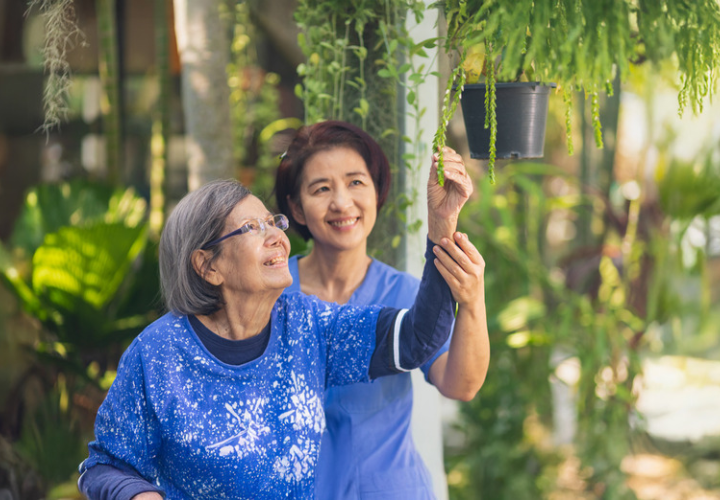
Formal exercise matters, especially strength and balance training. But healthy aging is also influenced by movement distributed across the day: walking to a shop or transit stop, using stairs when appropriate, carrying manageable loads, completing household work, gardening, standing during conversations, and maintaining errands, hobbies, and responsibilities.
That distinction matters because one workout cannot fully offset a day organized around sitting. It also makes activity more accessible. A person who dislikes gyms may still build a more active life by adding short walks, standing breaks, community classes, yard work, or active time with grandchildren. The goal is not to copy a Japanese routine. It is to find repeatable movements that fit the person, place, health history, and season of life.
Muscle is not mainly an appearance issue. It is a physical reserve. Strength and power help a person rise from a chair, recover from a stumble, climb steps, carry food, open a heavy door, and get off the floor. Regular movement also supports blood-sugar regulation, cardiovascular function, bone health, balance, mobility, and the ability to complete everyday tasks.
A 2023 umbrella review found that physical activity was associated with meaningful reductions in all-cause and cardiovascular mortality among older adults. That evidence supports regular activity, but it does not make one routine correct for everyone. Medical conditions, frailty, fall risk, pain, and current capacity should shape the plan.
Resistance training deserves special attention because ordinary activity may not provide enough challenge to preserve strength. Progress must be gradual, but it must also be meaningful. Why Those 5 lb Dumbbells Aren’t Enough Anymore explains why the body needs an appropriate training stimulus. Your Glutes Aren’t the Only Thing Squats Are Building explores how even brief muscle contractions can support metabolic health. The useful question is not whether an exercise looks impressive. It is whether it safely asks the body to adapt.
Advice to move more can sound simple until the neighborhood has no sidewalk, the nearest store is miles away, public transportation is limited, or summer heat makes outdoor activity unsafe. Habits depend partly on individual decisions and partly on what the environment makes possible.
Compact destinations, safe crossings, accessible transit, public parks, benches, community centers, and nearby gathering places create reasons to leave home and opportunities to move. Seeing peers active in public also sends a quiet message that older adults belong in shared spaces. In contrast, car-dependent communities and isolated housing can turn every outing into a major project.
This is why aging well cannot be assigned entirely to personal discipline. Families can help with transportation and companionship. Communities can design safer routes and inclusive programs. Healthcare teams can address pain, balance, vision, medication effects, and other barriers. Homes can be adapted for safety without removing every useful movement.
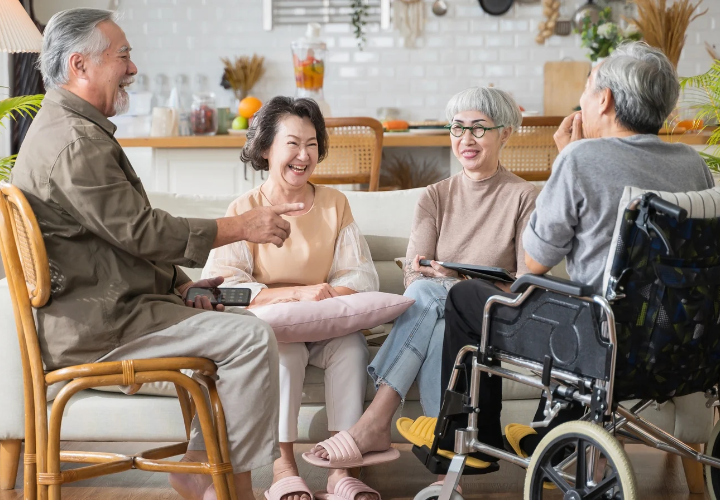
People are more likely to move when movement leads somewhere that matters. A walking group, volunteer role, class, garden, faith community, hobby club, or regular visit combines activity with purpose and connection. The body is active, but so are attention, memory, identity, and relationships.
A prospective study of older Japanese adults associated physically active, group-based leisure with lower mortality. Research on community gathering places in Japan has also linked participation with healthier aging outcomes. These are observational findings, so they cannot prove that a group activity caused a longer or healthier life. People who participate may differ in health, income, transportation, or social support. Even with that limitation, the pattern is worth noticing: movement may be easier to sustain when it is attached to belonging.
Purpose does not need to be grand. Cooking for a family meal, helping a neighbor, caring for a pet, sharing a skill, or keeping track of a weekly responsibility can reinforce the message that a person is still needed. Independence is not the absence of all help. It is having enough support to keep making choices and contributing.
Some Japanese traditions emphasize obligation, interdependence, and responsibility across generations. American families can use that lens to ask practical questions. Are older relatives included in ordinary family life? Do they still have meaningful roles? Do generations share meals, stories, decisions, and useful work? Are we providing support that expands independence, or taking over tasks a loved one could safely continue?
Multigenerational living can offer companionship, shared expenses, transportation, childcare, and faster help when health changes. It can also create privacy concerns, financial pressure, conflict, and significant caregiver burden. Living together is not the only measure of closeness, and it is not the right arrangement for every family. Regular contact, shared responsibilities, reliable transportation, and coordinated care can support connection across separate homes.
The goal is not to romanticize collectivism. Mutual support can be deeply protective, but obligation without resources can exhaust families. Healthy interdependence needs honest conversations about capacity, boundaries, money, safety, and respite.
Residential care, skilled nursing, rehabilitation, and memory support can be essential, compassionate, and clinically appropriate. Some people need round-the-clock nursing, complex medication management, intensive rehabilitation, or a safer environment than relatives can provide. Choosing that care is not a failure of love.
The more useful question is whether institutional care sometimes becomes the default because homes, transportation, healthcare, workplaces, and communities were not designed to support aging in place. OECD analysis describes Japan’s community-based integrated-care model, which coordinates healthcare, nursing care, prevention, housing, and livelihood support around the individual. The lesson is not that every person can or should remain at home. It is that families need options before a crisis removes them.
Any setting can either protect or erode function. Risks may include less spontaneous movement, loss of familiar routines, isolation, reduced autonomy, medication complexity, food that does not fit a person’s needs, and preventable decline. Those risks vary widely by person and facility. The standard should be the same everywhere: preserve movement, dignity, relationships, preferences, and meaningful choice whenever possible.
Aging in motion begins before frailty appears. Build and preserve muscle. Walk and move throughout the day. Practice strength and balance at an appropriate level. Monitor metabolic health, hormones, bone health, inflammation, nutrient status, vision, hearing, and medication effects with qualified clinicians. Protect meaningful roles and relationships. Adapt the home for safety while keeping safe activity in the day. Plan for future care before urgency makes every decision harder.
MyHealth1st’s hormone optimization resources for women in their 50s and beyond and men in later life explain how individualized assessment may fit within a broader healthy-aging plan. Hormones are one part of the picture, not a substitute for movement, nutrition, sleep, relationships, or appropriate medical care. The Lifestyle Program can help turn goals for muscle, food, movement, and body composition into repeatable daily practices.
A Level 2 Predictive Biomarker Assessment can establish a baseline for metabolic health, hormones, inflammation, nutrient status, and other factors that may influence healthy aging. For a practical muscle, movement, nutrition, and body-composition plan, schedule a Kickstart Consult.
Japan does not offer a blueprint that America can reproduce wholesale. It offers a prompt. What would change if we treated healthy aging not as something medicine delivers near the end of life, but as a physical, relational, and community practice built over decades?
Looking for practical support with nutrition, muscle preservation, movement, and body composition? Our Lifestyle Program can help you build sustainable habits that support your long-term health.
Schedule a Kickstart Consult to explore a personalized approach to aging with strength, independence, and vitality.
Dr. Jane Bowser is a certified health coach, nutritionist, and personal trainer, blending academic expertise with a passion for holistic wellness.