Most people know that regular exercise is important for health. We’ve been told to walk more, hit the gym, and find time for workouts.
But what if one of the most powerful metabolic tools wasn’t a 30-minute workout at all? What if it was simply standing up and doing 10 bodyweight squats several times throughout the day?
Emerging research suggests that frequent, short bursts of movement—often called exercise snacks—may have a profound impact on blood sugar control, insulin sensitivity, metabolism, and even healthy aging. In fact, a 2024 study found that performing 10 bodyweight squats every 45 minutes during a sedentary day improved blood sugar regulation more effectively than a single 30-minute walk. This finding challenges the traditional idea that all exercise benefits must come from longer, dedicated workouts.
The takeaway isn’t that walking is bad.
Walking remains one of the best forms of exercise for overall health and interval walking may be one of the best exercise forms of walking. Instead, the research highlights something many people overlook – how often we move may be just as important as how much we move.
The average American spends much of the day sitting. Whether working at a desk, commuting, watching television, scrolling through a phone, or attending meetings, prolonged sitting has become the norm. Unfortunately, our bodies were not designed for hours of uninterrupted inactivity. Even individuals who exercise regularly can experience negative health effects if they spend most of the remainder of the day sitting.
Researchers often refer to this phenomenon as the “active couch potato” effect—someone who exercises for an hour but remains sedentary for the other 15 waking hours.
After eating, glucose enters the bloodstream and must be transported into cells for energy. Skeletal muscle acts as one of the body’s largest glucose reservoirs.
When muscles remain inactive for extended periods, glucose uptake decreases, leading to larger post-meal blood sugar spikes. Over time, these repeated elevations can contribute to metabolic dysfunction and increase the risk of type 2 diabetes.
Insulin functions like a key that unlocks cells so glucose can enter. Prolonged inactivity reduces insulin sensitivity, meaning the body must produce more insulin to achieve the same effect.
As insulin resistance develops, blood sugar becomes harder to control, increasing the risk of obesity, metabolic syndrome, cardiovascular disease, and diabetes.
Movement helps pump blood throughout the body. Sitting for hours slows circulation, contributing to fatigue, stiffness, swelling, and vascular dysfunction.
Reduced blood flow can also affect nutrient delivery to tissues and impair overall cellular health.
Many people assume sitting conserves energy, but prolonged inactivity often has the opposite effect. Extended sitting can lead to sluggishness, brain fog, reduced concentration, and decreased productivity. Frequent movement breaks help restore circulation and stimulate the nervous system, often resulting in increased energy and mental clarity.
Research consistently links prolonged sedentary behavior to increased risks of:
The challenge is that modern life encourages sitting. Fortunately, there is a simple strategy that may help offset many of these risks.
An exercise snack is exactly what it sounds like: a small “bite” of movement performed throughout the day. Rather than relying solely on a single workout session, exercise snacks involve brief periods of activity lasting anywhere from 30 seconds to a few minutes.
Examples include:
The goal is not to become exhausted. The goal is simply to interrupt prolonged sitting and activate large muscle groups regularly throughout the day.
Research shows that these short activity breaks can improve glucose control, insulin response, circulation, blood pressure, and energy levels while helping combat the negative effects of sedentary behavior. A 2024 study published in the Scandinavian Journal of Medicine & Science in Sports examined how different movement patterns affected blood sugar control in overweight and obese men. Participants completed four separate conditions:
Researchers found that both the walking-break group and the squat-break group experienced significantly better blood sugar control compared with uninterrupted sitting. Interestingly, the frequent movement breaks produced greater benefits than the single 30-minute walk. The squat condition was particularly effective, likely because squats activate large muscle groups including the quadriceps and gluteal muscles. These muscles act like glucose sponges, pulling sugar out of the bloodstream when they contract. (Nutrition Evidence)
This does not mean squats replace walking. Walking offers numerous cardiovascular, mental health, and longevity benefits. However, the study highlights an important lesson: breaking up sitting frequently may provide unique metabolic benefits that one daily exercise session cannot fully replicate. (Nutrition Evidence)
Bodyweight squats are one of the most efficient exercises available because they recruit some of the largest muscles in the body.
Every squat activates:
These muscles require energy to contract. To meet that demand, they pull glucose from the bloodstream. This process occurs through mechanisms that are partially independent of insulin, making muscle contractions especially valuable for blood sugar regulation. In simple terms, every time you perform a few squats, your muscles help clear excess glucose from circulation.
Over the course of a day, dozens of these small movement breaks can create a significant cumulative effect.
Healthy aging isn’t simply about avoiding disease. It is about preserving function.
One of the strongest predictors of longevity is maintaining muscle mass and strength as we age.
Unfortunately, prolonged sitting contributes to muscle loss, decreased insulin sensitivity, and reduced physical function.
Exercise snacks provide a practical strategy for keeping muscles active throughout the day. Emerging research suggests these brief activity breaks may help preserve metabolic health, improve blood flow, support cognitive function, and maintain physical performance as we age. Regular movement also supports healthy blood pressure, cardiovascular function, and glucose control—all key factors associated with longer health span and lifespan. (PMC)
The beauty of exercise snacks is that they are accessible to almost everyone.
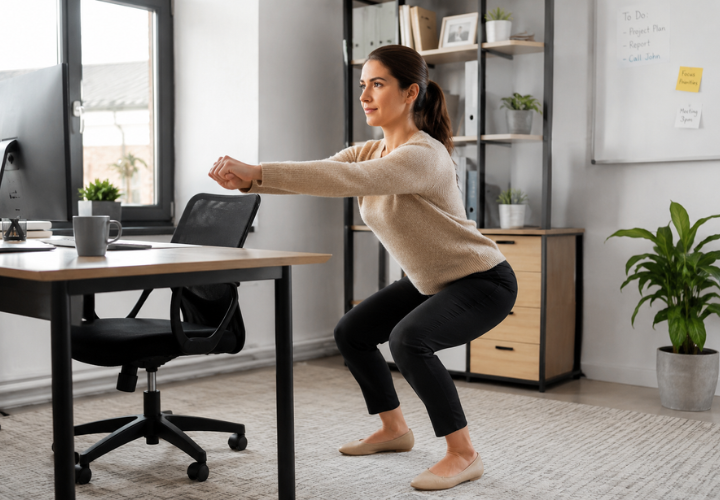
If you’re new to the concept, start small.
Set a timer on your phone or smartwatch.
Every 45 to 60 minutes, stand up and perform 10 controlled squats.
The entire process takes less than 30 seconds.
Post-meal movement is particularly effective for blood sugar management.
Try performing 10–20 squats after breakfast, lunch, and dinner to help reduce glucose spikes.
No need to start out going for the gold! If traditional squats feel challenging, use a chair.
Simply sit down and stand up repeatedly using good control and without using your arms to help. Chair squats activate many of the same muscles while providing additional support and confidence.
One of the biggest misconceptions about fitness is that every workout needs to be intense.
In reality, health often improves through repeated, consistent actions. Ten squats may not seem like much, but ten squats performed ten times throughout the day equals 100 squats.
More importantly, those 100 squats interrupt hours of sedentary time and repeatedly stimulate the muscles responsible for metabolic health. The most effective strategy is not necessarily the hardest one. It’s the one you’ll actually do.
Want to take it to the next level? Try this.
Every time you go to the bathroom, do a mini workout.
Don’t have to go to the bathroom that often? Time to up your hydration. It’s a Win Win!
Walking remains an incredible tool for health, fitness, and longevity. But new research suggests that frequently interrupting sitting with simple bodyweight squats may provide unique metabolic benefits that rival—and in some situations exceed—the benefits of a single daily walk when it comes to blood sugar control. In a world where most people spend hours sitting, movement doesn’t have to be complicated.
Stand up. Do 10 squats. Repeat throughout the day.
If you’re looking for personalized guidance on improving metabolic health, preserving muscle, optimizing nutrition, and creating sustainable habits that fit your lifestyle, we’re here to help.
Schedule a Kickstart Consult today and discover how simple, science-backed strategies can help you improve your metabolism, preserve muscle, increase energy, and take control of your health for years to come.
References

Dr. Jane Bowser is a certified health coach, nutritionist, and personal trainer, blending academic expertise with a passion for holistic wellness.