We often hear that food is “fuel.” It is. But that description leaves out something fascinating. Food is also raw material. The food you eat today does not simply disappear after providing a certain number of calories. Your digestive system breaks food apart into smaller components, your body absorbs those components, and your metabolism decides where they go and what to do with them.
Some may be used immediately for energy or stored for later. Some become ingredients for building and repairing tissues. Some participate in chemical reactions. Some help produce signaling molecules. Some feed the trillions of microorganisms living in your digestive tract. And some, quite appropriately, end up in the bathroom.
In other words, parts of your breakfast, lunch, or dinner can eventually contribute to the molecules your body uses to build, signal, repair, store, and function. That is a much bigger idea than simply “food is fuel.”
And it is also why how food affects your body cannot be reduced to calories alone.
Before your body can use the nutrients in a meal, it has to dismantle that meal. Digestion begins in your mouth. Chewing physically breaks food down, while saliva begins the digestion of starches. From there, food travels through the esophagus to the stomach, where muscular contractions mix it with acid and digestive enzymes.
The small intestine is where much of the action happens. Digestive enzymes from the pancreas and digestive substances such as bile help break carbohydrates, proteins, and fats into smaller components. Those components can then cross the intestinal lining and enter circulation. (NIDDK)
Think of your digestive system as a very sophisticated recycling and sorting facility. A chicken breast doesn’t travel through your bloodstream as a tiny chicken breast! It is broken down into amino acids and other compounds. An avocado doesn’t become an avocado-shaped piece of your cell membrane… Its fats are broken down and processed into fatty acids and other molecules that your body can use or store.
A potato doesn’t simply become “energy.” Its carbohydrates are digested into smaller sugars, including glucose, which can be used for energy, stored as glycogen, or used in other metabolic pathways. The raw ingredients change form before your body can put them to work.
Calories tell you how much energy a food can provide. Macronutrients tell you something about what that food is made of and what your body can do with it.
Protein is broken down into amino acids. Your body uses amino acids to build and maintain proteins throughout the body, including structural proteins in muscle and connective tissue, enzymes, transport proteins, antibodies, and many other essential components. Some amino acids also participate in pathways that produce important molecules involved in nervous-system function and other physiological processes. (PubMed)
This is one reason protein needs are about more than “getting enough grams.” Your body is constantly breaking down and rebuilding proteins. Exercise can increase the demand for muscle repair and remodeling. Illness, injury, growth, pregnancy, aging, and other circumstances can also change protein needs.
So, when you eat protein, you are not simply checking a box on your macro tracker. You are supplying raw materials. For more on this, see our article on protein and building a leaner, stronger body.
Dietary fat is broken down primarily into fatty acids and other components. Those fatty acids can be burned for energy, stored, or incorporated into structures throughout the body. Certain fats are important components of cell membranes, and dietary fats also interact with pathways involved in signaling and metabolism. Fat also helps your body absorb fat-soluble vitamins such as vitamins A, D, E, and K.
And because fat is energy-dense, it provides a substantial energy reserve when stored in adipose tissue. That does not mean eating dietary fat simply “turns into body fat.” Although, if you were listening to health news in the 80’s and 90’s, you may have come to believe that! The truth is your body’s energy storage is considerably more complicated than that. Whether energy is stored or used depends on total energy availability, hormones, activity, metabolism, and many other factors. You can learn more in How Eating Fat Helps You Burn Fat.
Carbohydrates are broken down into simple sugars that your body can use for energy. Glucose is particularly important because many of the body’s cells can use it as a fuel source. Your body can also store glucose as glycogen, primarily in the liver and muscles, for later use. But carbohydrates are not simply “sugar.”
The form in which you consume them matters. A whole piece of fruit comes packaged with water, fiber, micronutrients, and a physical structure that affects how quickly it is eaten and digested. Fruit juice has a different physical structure. A highly processed carbohydrate may behave differently again. The food itself is more than its carbohydrate number. That is part of what scientists mean when they talk about the food matrix: nutrients exist within a physical structure, and that structure can influence digestion, absorption, satiety, and metabolic responses. (PubMed)
For a deeper dive, read Carbohydrates: The Most Misunderstood Macro.
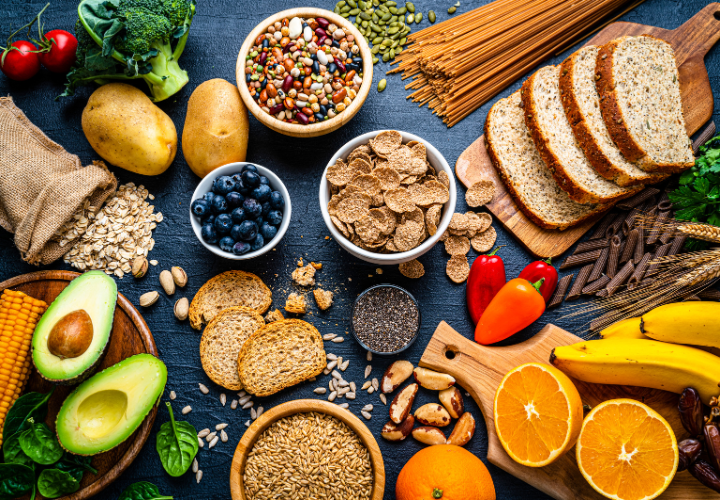
Vitamins and minerals don’t provide calories in the way carbohydrates, protein, and fat do. But “doesn’t provide calories” should never be confused with “doesn’t matter.” Micronutrients participate in hundreds of biological processes. They help enzymes perform chemical reactions. They support blood formation, nerve function, immune processes, bone health, energy metabolism, antioxidant systems, and much more.
In other words, macronutrients provide substantial amounts of energy and raw material, while micronutrients help your body’s machinery actually use those materials correctly.
Imagine trying to build a house with plenty of lumber, bricks, and steel but no nails, electrical components, tools, or wiring. Technically, you have a lot of building material… but good luck finishing the house!
The same principle applies to nutrition. A person can consume enough calories to meet energy needs and still have nutritional gaps. Adequate energy intake does not automatically guarantee adequate micronutrient intake. NIH’s Office of Dietary Supplements maintains consumer and professional resources on individual vitamins and minerals because each has distinct roles and requirements. (Office of Dietary Supplements)
This is one reason a nutrition conversation that stops at calories can miss a large part of the picture.
And you’re not the only one eating your lunch—your gut microbes are eating, too.
Your digestive tract is not simply a long pipe carrying food from point A to point B. It is an ecosystem. Your gut contains trillions of microorganisms, and what you eat helps shape the environment in which those microorganisms live.
One particularly interesting example is dietary fiber. Humans cannot fully digest many types of fiber with our own digestive enzymes. Some fiber reaches the colon, where gut microorganisms can ferment it and produce compounds called short-chain fatty acids.
Those compounds can interact with intestinal cells and other systems throughout the body. The relationship between dietary fiber, the microbiome, and these microbial metabolites is an active area of research. Importantly, responses vary according to the type and amount of fiber and the individual. (PubMed)
So when you eat a fiber-rich meal, you are potentially feeding more than yourself. You’re feeding an ecosystem that interacts with you.
That does not mean every person needs a particular “gut-healing” food, supplement, or microbiome protocol. Nutrition is rarely that straightforward. It does mean that food quality, variety, fiber intake, and overall dietary pattern can matter for reasons that extend beyond calories and macros.
Here’s where nutrition gets particularly interesting. Two people can eat the same meal and experience different physiological responses. Their responses can be influenced by factors including body composition, activity, metabolic health, sleep, medications, meal composition, timing, and the gut microbiome.
Research examining post-meal glucose responses has found substantial variation between individuals eating the same foods. In one large cohort, personalized models that incorporated individual characteristics and microbiome information predicted glucose responses better than approaches based on calories or carbohydrates alone. (PubMed Central (PMC))
That doesn’t mean calories or carbohydrates are irrelevant. It means they are pieces of the puzzle rather than the entire puzzle.
Even your response to fiber can vary. Research suggests that differences in gut microbial composition and function may contribute to different responses to specific fiber interventions. (PubMed). This is why generic nutrition advice can be useful as a starting point but insufficient as a complete strategy. Statements like:
“Eat more protein.”
“Eat less sugar.”
“Eat more fiber.”
“Watch your carbs.”
“Eat healthy fats.”
All of these statements can contain useful information…
But the more interesting question is:
What does YOUR body actually need?
There is a tendency to label certain foods as either “good” or “bad.” Biology doesn’t really work that way. A food exists within a context. Its portion matters. Its preparation matters. Its processing matters. What you eat alongside it matters. In many cases, when you eat it matters. How frequently you eat it matters. Your overall dietary pattern matters. And… the person eating it matters.
A whole potato, a serving of French fries, and a glass of potato-based beverage may contain carbohydrates originating from the exact same plant, but they do not have the same physical structure, accompanying nutrients, eating experience, or metabolic context. The same principle applies across nutrition.
Food is not simply a bag of isolated nutrients. It is a package. And your body responds to the whole package.
You do not need to leave this blog convinced that every bite of food must be optimized at all costs! That would be exhausting. Instead, try three practical upgrades:
Before asking, “How many calories are in this?” ask:
What am I giving my body to work with?
Does the meal contain a meaningful protein source?
Does it provide a useful source of fiber-rich carbohydrates or plants?
Does it contain a source of dietary fat?
Does it contribute vitamins, minerals, and other beneficial compounds?
Don’t get me wrong. Calories still matter, particularly when body composition or metabolic health is a goal. But they are not the whole story.
You do not need “perfect” food. You need a pattern that consistently supplies the raw materials your body requires. A nutrient-dense meal doesn’t erase an afternoon cookie. A cookie doesn’t erase an otherwise nourishing diet. Food is neither morally pure nor poisonous in isolation. Dose, pattern, preparation, source, and the person all matter. In other words — the goal is not dietary perfection. It is building a pattern that does more of the heavy lifting for you.
This is where nutrition becomes personal. Take time to check in and ask yourself:
How do you feel after different meals? How long are you comfortably full? What happens to your energy? How is your digestion? How are your cravings? What happens to your body composition over time? What do relevant labs or other measurements show? And, when appropriate, what happens to markers such as blood glucose?
Instead of endlessly collecting random nutrition “rules” from the internet, you can start asking better questions about your own physiology. That is the difference between generic nutrition advice and personalized nutrition.

The next time you sit down to eat, pause for a moment. Not to judge the food, and not to calculate whether you have been “good.” Just to get curious.
What raw materials am I giving my body most often?
Because food isn’t simply something you consume and then forget. Your digestive system takes it apart. Your body sorts, transforms, stores, uses, and eliminates what you provide. Nutrients become substrates for energy production, building blocks for proteins and other molecules, components of cellular structures, inputs into metabolic pathways, and fuel for your gut ecosystem. (NIDDK)
That is why understanding how food affects your body can change the way you think about nutrition. You are not just feeding a calorie balance, but you are supplying a living, constantly remodeling organism with its raw materials.
Again, the goal isn’t to find the one “perfect” diet. It is to figure out which foods, portions, patterns, and habits give your body what it needs to function, repair, adapt, and thrive.
At MyHealth1st, that is where we believe nutrition gets more useful.
We move beyond generic slogans and one-size-fits-all food rules toward a measured, personalized plan built around your goals, body composition, symptoms, lifestyle, relevant health measurements, and if you know us — your blood type.
If you are ready to understand what your body needs rather than simply collecting more nutrition advice, a Kickstart Consultation is a place to begin.
And if you want to keep exploring the building blocks, start with our Macros Matter series, Muscle as Medicine, Modern Body Composition Crisis, and Personalized Nutrition and Health Coaching.
Because the most useful nutrition question may not be:
“What should I eat?”
It may be:
“What am I asking my body to build itself from?”

Erin is a National Board Certified and Functional Medicine Certified Health Coach with a passion for fitness, holistic wellness, and ethical food production.