
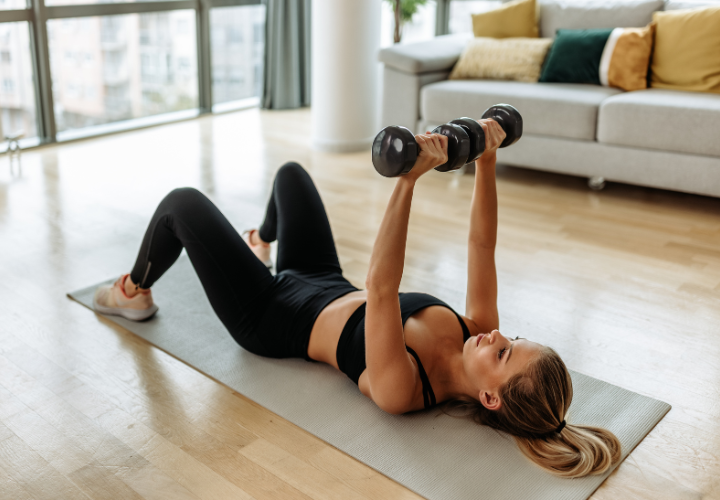
Take a look around most commercial gyms, Pilates studios, or home workout setups, and you’ll notice something interesting: a lot of people have been faithfully lifting the same 3, 5, or 8 pound dumbbells for years. Yep… Years.
Meanwhile, they’re wondering why their arms don’t look more defined, why their metabolism seems slower than it used to be, or why they don’t feel stronger despite exercising regularly.
If that’s you, you’re not alone. And before anyone starts clutching their 2 pound pink dumbbells in panic, let’s be clear: light weights absolutely have their place.
But if you’ve been doing the exact same workout with the exact same weights for months (or years), your body may have already sent you a memo. The problem is that the memo was written in muscle physiology, and most of us don’t speak that language. Let’s translate.
Why Muscle Matters More Than Most People Realize
When most people think about health, they think about body weight. When most people think about fitness, they think about cardio. But when researchers look at healthy aging, independence, metabolism, injury prevention, blood sugar regulation, and overall longevity, muscle mass repeatedly shows up as one of the most important predictors of long-term health.
Muscle tissue is metabolically active, meaning it requires energy to maintain. While muscle doesn’t magically turn your body into a calorie-burning furnace overnight, having more lean muscle mass generally supports a healthier metabolism compared to having less.
Muscle also acts as a major storage site for glucose (a glucose parking garage, if you will), helping improve insulin sensitivity and blood sugar regulation. It also supports balance, protects joints, reduces fall risk, and helps preserve independence as we age.
The Early Signs of Age-Related Muscle Loss
And here’s the unfortunate part that surprises many people:
The age-related loss of muscle mass, known as sarcopenia, often begins much earlier than people realize. Many assume muscle loss starts sometime around age 70. In reality, muscle mass can begin gradually declining as early as our 30s, especially if we’re sedentary or not engaging in resistance training.
The process is slow enough that most people don’t notice it at first. You don’t wake up one morning and say, “Well, there go my biceps!” Instead, it shows up in subtle ways:
- Carrying groceries feels harder.
- Your metabolism isn’t quite what it used to be.
- Recovery takes longer.
- Taking the stairs suddenly seems more challenging than it was a few years ago.
The good news? Resistance training is one of the most effective tools we have to slow, prevent, and even reverse much of this process.
Why Beginners Should Start With Light Weights
Now, before you sprint to the gym and attempt to deadlift a small rhinoceros, let’s talk about where everyone should begin. Light weights are fantastic for beginners. In fact, they’re often exactly what you need. When you’re learning a new movement, your nervous system is trying to figure out a lot of things at once:
- Where your body is in space
- How to stabilize your joints
- Which muscles should be firing
- How to coordinate movement patterns
- How to maintain proper posture and alignment
Adding heavy loads before mastering these skills is like trying to learn how to drive while simultaneously entering a Formula 1 race. Skill improvement takes time!
The goal early on isn’t to impress anyone. The goal is to learn. For example, learning proper squat mechanics, hinge patterns, pushing and pulling movements, core engagement, and body awareness creates a foundation that will allow you to safely progress later. So if you’re new to exercise, those 5 pound dumbbells may be exactly where you should start. The key word is start.
How Your Body Adapts to Exercise
The Problem: Your Body Loves Efficiency
Your body is remarkably adaptable. It’s also remarkably lazy. Not lazy in a bad way… Just efficient. If you repeatedly ask it to perform the same task under the same conditions, it becomes better at that task while expending less effort. This is called adaptation.
Let’s say you begin doing shoulder presses with 5 pound dumbbells. At first, they’re challenging. Your muscles are working hard. You feel sore afterward. Your body receives a clear message: “Hey, we should probably get stronger.” So it adapts.
After a few weeks, those same dumbbells no longer create the same challenge. Your muscles have essentially responded: “Got it. Mission accomplished.” But many people keep performing the exact same workout anyway.
Three sets. Twelve reps. Five pounds. Forever.
At that point, you’re mostly maintaining your current abilities rather than creating a stimulus for additional growth.
Enter: Progressive Overload
What Is Progressive Overload?
Progressive overload sounds complicated, but the concept is actually simple. To continue improving, you must gradually increase the challenge placed on your muscles. That’s it. Your body adapts to stress. To keep adapting, it needs a new challenge. That challenge can come from:
- Heavier weights
- More repetitions
- More sets
- Slower tempos
- Longer time under tension
- Reduced rest periods
- More advanced exercise variations
- Increased training frequency
The important principle is that the stimulus must continue progressing over time. Think of it like learning a language. If all you ever practice is “Hello, how are you?” you’ll never become fluent. Your muscles operate similarly. They need increasingly difficult conversations, or you’ll never reach your full fitness potential.
Can You Build Muscle Without Heavy Weights?
Absolutely. In fact, some people build incredibly impressive physiques using bodyweight training alone. Gymnasts are a perfect example. Nobody looks at an elite gymnast and thinks, “Wow, it’s unfortunate they never discovered dumbbells.” Bodyweight training can be incredibly effective because advanced movements become extraordinarily challenging.
Push-ups become decline push-ups. Then ring push-ups. Then one-arm push-up progressions.
Squats become split squats. Then Bulgarian split squats. Then pistol squats. The challenge continues increasing.
Muscle doesn’t care whether resistance comes from a barbell, a machine, a dumbbell, or your own body weight. It only cares whether it’s being challenged enough to adapt.
How to Make Light Weights More Effective
The Catch: Light Weights Require More Strategy
Here’s where many people get tripped up. If you’re not progressively increasing external load, you need other ways to keep challenging the muscle. Simply waving 3 pound dumbbells around while chatting about weekend plans isn’t likely to produce significant muscle growth. To make lighter loads effective, you need to focus on factors like:
Training Close to Failure
Muscle growth is stimulated when muscle fibers are recruited and challenged sufficiently. One way to accomplish this is by training close to muscular failure. In simple terms, that means reaching a point where performing additional repetitions with good form becomes extremely difficult. Not “slightly uncomfortable.” Not “I could probably do another 25 reps.” Actually challenging… like your muscle might just burst into flame.
Increasing Time Under Tension
Time under tension refers to how long your muscles are actively working during a set. For example:
- Lowering slowly during a squat
- Pausing at the bottom
- Pulsing movements
- Controlling and slowing down the lifting phase
Suddenly, those lighter weights feel MUCH less cute. A five pound dumbbell lifted with complete control can become surprisingly challenging.
Progressing Exercise Difficulty
This is where Pilates, barre, yoga, and bodyweight programs often shine. The issue isn’t that these workouts are ineffective. The issue is when people stop progressing. If your workout feels exactly the same today as it did six months ago, your body has likely adapted.
Progression might involve:
- Harder exercise variations
- Greater range of motion
- Longer holds
- More repetitions
- Improved control
- Increased resistance bands
- More advanced movement patterns
Basically, the challenge should evolve as you do.
Here’s where many people get tripped up. If you’re not progressively increasing external load, you need other ways to keep challenging the muscle. Simply waving 3 pound dumbbells around while chatting about weekend plans isn’t likely to produce significant muscle growth. To make lighter loads effective, you need to focus on factors like:
Training Close to Failure
Muscle growth is stimulated when muscle fibers are recruited and challenged sufficiently. One way to accomplish this is by training close to muscular failure. In simple terms, that means reaching a point where performing additional repetitions with good form becomes extremely difficult. Not “slightly uncomfortable.” Not “I could probably do another 25 reps.” Actually challenging… like your muscle might just burst into flame.
Increasing Time Under Tension
Time under tension refers to how long your muscles are actively working during a set. For example:
- Lowering slowly during a squat
- Pausing at the bottom
- Pulsing movements
- Controlling and slowing down the lifting phase
Suddenly, those lighter weights feel MUCH less cute. A five pound dumbbell lifted with complete control can become surprisingly challenging.
Progressing Exercise Difficulty
This is where Pilates, barre, yoga, and bodyweight programs often shine. The issue isn’t that these workouts are ineffective. The issue is when people stop progressing. If your workout feels exactly the same today as it did six months ago, your body has likely adapted.
Progression might involve:
- Harder exercise variations
- Greater range of motion
- Longer holds
- More repetitions
- Improved control
- Increased resistance bands
- More advanced movement patterns
Basically, the challenge should evolve as you do.
The Truth About “Toning” and Muscle Definition
Let’s address one of fitness marketing’s favorite buzzwords, and a term that’s made me roll my eyes a bit since I started teaching fitness 13 years ago… “Toning.”
Especially when aimed at women, fitness advertisements often promise long, lean, “toned” muscles. This is usually accompanied by a photo of someone with a nice physique holding a pink dumbbell and smiling suspiciously.

Here’s the reality: Toning is not a physiological process. It is not a verb. Muscles do not become “toned.” They either grow or they don’t. Body fat decreases to the level where muscle becomes visible… or it doesn’t.
What most people describe as a toned appearance is simply:
- Having enough muscle mass to create shape and definition.
- Having a low enough body fat percentage to see that shape and definition.
That’s it. There’s no secret toning workouts! No magical toning rep range. If you want visible muscle definition, you need muscle.
Another common fear I hear from many women is that they will get “too big or bulky” from strength training… nope. I promise you that won’t happen. Women who achieve large “bulky” physiques (for example, to compete in a physique or body building show) work for YEARS and dial in every aspect of their nutrition, fitness and supplementation to achieve that precise physique goal. I guarantee you it won’t happen to you by accident.
Many women who think they look “bulky” simply have an excess of adipose tissue (body fat) covering their lean tissue (muscle). And this brings me to nutrition:
If you want to see that hard-earned muscle, body fat levels matter too. This is why nutrition plays such a critical role. You can build muscle successfully, but if body fat remains high enough to obscure it, the visual definition many people seek won’t be apparent.
Conversely, becoming very lean without sufficient muscle mass often produces a smaller version of the same physique rather than the sculpted appearance people are hoping for.
Are Your 5 Pound Dumbbells Still Challenging Enough?
Maybe. If you’re brand new to strength training, they may be perfect. If you’re recovering from injury, they may be appropriate. If you’re using them within a progressively challenging program that pushes your muscles close to fatigue, they can absolutely be effective.
But if you’ve been lifting the same 5 pound dumbbells for years while waiting for dramatic changes in strength, muscle definition, or body composition, it may be time for an honest conversation.
Your muscles have probably adapted. But guess what… Adaptation is not failure! It’s actually evidence that your body did exactly what it was supposed to do. The solution isn’t to quit. The solution is to provide a new challenge moving forward.
Your future self will thank you. Your metabolism will thank you. Your bones, joints, and blood sugar will thank you.
And someday, when you’re carrying groceries, picking up grandkids, climbing stairs, or simply living life with strength and confidence, you’ll be grateful you didn’t spend decades avoiding anything heavier than your purse. 😉
How Health Coaching Can Help You Build Strength Safely
Knowing you should challenge your muscles is one thing. Knowing exactly how to do it safely and effectively is another.
At MyHealth1st, our health coaches help patients create realistic nutrition and exercise plans based on their current fitness level, goals, lifestyle, and health history. Whether you’re brand new to strength training, trying to lose body fat, build muscle, improve your metabolism, or simply age as strongly as possible, we’re here to help.
Schedule a Kickstart Consultation with one of our health coaches today and let’s build a plan that works for your body, your schedule, and your goals. Because healthy aging isn’t something that happens by accident. It’s something you train for.
Erin Paly
Erin is a National Board Certified and Functional Medicine Certified Health Coach with a passion for fitness, holistic wellness, and ethical food production.