
Welcome back to our Health at Home series, where we take a closer look at the everyday products and routines that surround us and ask a simple question:
Is this actually helping my health… or working against it?
Today, we’re talking about something almost all of us do – sometimes multiple times per week.
Laundry is one of those household chores that feels completely harmless. Toss clothes in the washer. Add detergent. Press a button. Walk away. Maybe you even feel a tiny sense of accomplishment when you open the dryer and are greeted by the warm, fresh-smelling pile of clean clothes.
Yet here’s where things get interesting:
That “fresh laundry smell” many of us associate with cleanliness may actually be the scent of chemicals designed to linger on our clothing, bedding, and towels for days, weeks, or even longer.
At the same time, while your laundry detergent is busy removing dirt, sweat, and mystery stains (because apparently children can turn a clean shirt into an archaeological artifact within minutes), it may also be exposing your body to ingredients that aren’t exactly ideal for long-term health.
Most conventional laundry detergents are designed with three main goals:
The problem is that ingredients used to achieve these goals can come with unintended consequences.
Many traditional laundry products contain ingredients such as synthetic fragrances, preservatives, surfactants, dyes, and other chemical additives that may contribute to increased exposure to environmental toxins.
Although one load of laundry is unlikely to dramatically change your health overnight, the concern comes from repeated, long-term exposure.
For example, think about it:
Your skin is your largest organ. Clothes touch your skin all day. Bed sheets surround you for roughly one-third of your life. Bath towels come into contact with freshly washed skin.
Basically, your laundry detergent gets a backstage pass to your daily life. And unfortunately, not every ingredient invited backstage deserves VIP access.

Let’s start with one of the biggest offenders: fragrance.
The word “fragrance” sounds innocent enough. It brings to mind fresh flowers, clean cotton, sunshine, and maybe a perfectly folded towel sitting in a luxury spa bathroom.
But legally, the term “fragrance” can represent a mixture of dozens, sometimes hundreds, of individual chemical ingredients. Companies are often not required to disclose every component because fragrance formulas can be considered proprietary.
As a result, a single word on a label can hide an entire cocktail of compounds.
Some synthetic fragrance ingredients have been associated with:
Certain fragrance chemicals may act as endocrine disruptors, meaning they can interfere with the body’s natural hormone signaling pathways.
Your endocrine system is essentially your body’s communication network. Hormones help regulate metabolism, reproductive health, mood, stress response, sleep, and countless other processes.
Consequently, when chemical compounds interfere with these signals, it’s like someone repeatedly interrupting a conversation between your body’s systems.
Not exactly the kind of “communication breakdown” we’re hoping for.
Endocrine-disrupting chemicals (EDCs) are compounds that may interfere with normal hormone function.
Research has linked exposure to certain endocrine disruptors with concerns related to:
Common household sources of endocrine-disrupting chemicals can include certain plastics, personal care products, cleaning products, pesticides, and yes, some laundry products.
That said, it’s important to remember that exposure does not automatically equal harm. Our bodies are incredibly resilient and have sophisticated detoxification systems.
However, modern life often involves exposure to hundreds of chemicals every day from multiple sources. While any single product may seem insignificant, the bigger picture is cumulative exposure over time.
In other words:
A tiny drop may not seem like much. Although, when the bucket is constantly being filled, it’s eventually worth asking what’s in the bucket.
One of the biggest marketing tricks in household products is convincing us that a chemical smell equals cleanliness. We’ve been trained to think:
In reality your laundry doesn’t need to smell like a tropical vacation collided with a perfume counter to be clean.
Clean clothes smell like… clean clothes.
Wild concept, right?
Many people who switch to fragrance-free or lower-toxicity laundry products notice something surprising: after a while, conventional scented detergents begin to smell overpowering.
The brain is adaptable. Once you step away from artificial fragrances, your definition of “fresh” often changes.
When choosing a laundry detergent, a few things can help reduce unnecessary chemical exposure:
Fragrance-free options are often a great starting point, especially for individuals with sensitive skin, allergies, eczema, hormonal concerns, or respiratory issues.
Keep in mind: “unscented” and “fragrance-free” are not always the same thing. Some unscented products may still contain masking fragrances designed to cover chemical odors.
Likewise, companies that clearly disclose ingredients make it easier for consumers to make informed decisions.
A short ingredient list is often a good sign. Your laundry detergent probably does not need a novella of ingredients longer than your grocery receipt.
Colorful detergent pods and beautifully scented bottles may look appealing, but the goal of laundry detergent is to clean your clothes, not win a beauty pageant.
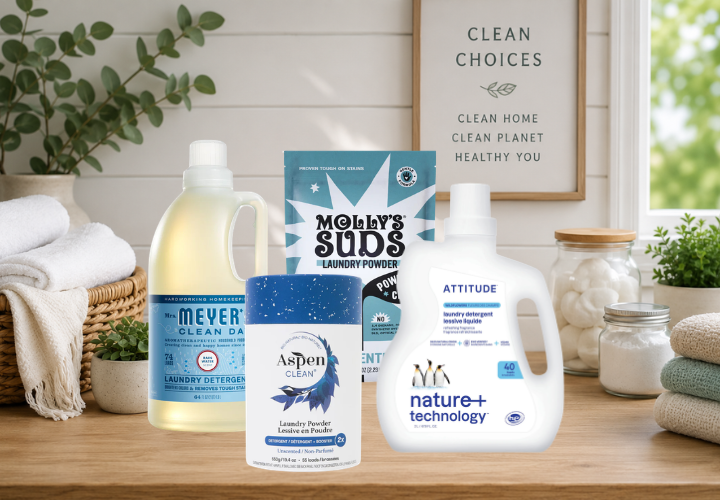
The good news? You do not have to choose between dirty laundry and a chemical experiment happening in your washing machine. There are many brands focused on creating lower-toxicity alternatives.
Molly’s Suds has become popular among people looking for simpler laundry products made with fewer ingredients. Their laundry powders and products are designed around plant-based ingredients and avoid many common additives found in conventional detergents.
Attitude offers a wide range of household products, including laundry detergents designed with ingredient transparency in mind. Many of their products are made without certain ingredients commonly avoided by consumers looking for cleaner household options. They also focus heavily on environmental considerations, which is a bonus because your health and the planet’s health are often more connected than we realize.
AspenClean creates household cleaning products with an emphasis on plant-based ingredients and avoiding unnecessary synthetic chemicals. Their laundry products are designed for people who want effective cleaning without bringing a chemistry experiment into their laundry room.
Mrs. Meyer’s Clean Day is another popular option among consumers looking for alternatives to conventional cleaning products. While some products contain fragrance, the brand is often chosen because of its focus on ingredient standards and avoidance of certain harsher additives. If fragrance sensitivity or hormone concerns are a priority, it is still worth reading labels carefully and selecting the options that best align with your personal goals.
When people learn about environmental toxins, they sometimes feel overwhelmed. There are chemicals in our food packaging. Our cleaning products. Our cosmetics. Our furniture. Our air.
It can start to feel like you need to move into a cabin in the woods, grow your own vegetables, and wash your clothes in a nearby stream. (Although if you have ever tried hand-washing jeans, you quickly realize modern appliances deserve at least a little appreciation!)
The goal is not perfection. It is awareness. Making small, realistic changes can reduce your overall chemical burden over time. Switching laundry detergent is one simple place to start because it is something you use repeatedly and something that comes into direct contact with your body.
You don’t have to replace everything in your home overnight. Start with one product. Then another. Progress beats perfection every time.
If you have been struggling with unexplained symptoms such as difficulty losing weight, fatigue, hormone imbalances, brain fog, poor sleep, or changes in your overall wellbeing, it may be worth taking a closer look at the bigger picture.
Your health is influenced by many factors, including nutrition, lifestyle, genetics, stress, hormones, and environmental exposures.
At MyHealth1st, our comprehensive biomarker assessments help identify areas where your body may need additional support. By evaluating key markers related to metabolism, hormones, inflammation, nutrient status, and overall wellness, we can create a personalized roadmap designed around your unique needs.
Because, at the end of the day, optimizing your health is not about chasing the newest trend or replacing every product in your house with something labeled “natural.” It is about understanding your body, identifying opportunities for improvement, and making intentional choices that support the way you want to feel.
Ultimately better health starts with big changes. Sometimes it starts with something as simple as what you pour into your washing machine.

Erin is a National Board Certified and Functional Medicine Certified Health Coach with a passion for fitness, holistic wellness, and ethical food production.