
This is the first post in our Health at Home series. We’re starting with the foundation of life itself: water. Each month, we’ll build on this foundation with new topics to help you create a healthier home environment.
Ready to dive in?
Water is involved in nearly every function in the human body. It helps:
Most conversations about hydration focus on how much water we drink, but an equally important question is:
New research in biology and physics shows that the quality and physical properties of water may influence how fluids behave inside the body — affecting circulation, inflammation, and cellular health. At the same time, concerns about environmental contaminants have increased interest in improving drinking water through advanced filtration systems, including reverse osmosis technologies like AquaTru.
Water acts as the body’s main transportation system. Nutrients, hormones, electrolytes, and waste products all move through water-based fluids.
Because of this, anything dissolved in drinking water may also enter the body.
Depending on where water comes from and how it is treated, it may contain:
Long-term exposure to certain contaminants has been linked to increased health risks.
Research shows that reverse osmosis (RO) filtration can significantly reduce substances such as arsenic and other dissolved contaminants. Large scientific reviews have found that RO systems improve water quality by lowering:
From a functional medicine perspective, reducing exposure to toxins may help support metabolism, immune function, and long-term wellness.
Hydration affects far more than thirst. Studies show that proper hydration can influence inflammatory pathways in the body. In one controlled human study, adequate fluid intake during heat exposure reduced inflammatory signaling and lowered stress responses in cells.
Hydration helps regulate:
In short:
Both the amount and the quality of water matter.
Zeta potential is a concept from chemistry and biophysics that helps explain how particles behave in fluids.
Simple Definition: Zeta potential is the electrical charge surrounding particles suspended in liquid.
This charge determines whether particles:
Your red blood cells naturally carry a negative electrical charge. This charge causes cells to gently repel one another, allowing blood to flow smoothly through tiny vessels.
When zeta potential is healthy:
When it decreases:
Many factors influence this balance, including:
This helps explain why hydration and mineral balance may indirectly support healthy circulation.
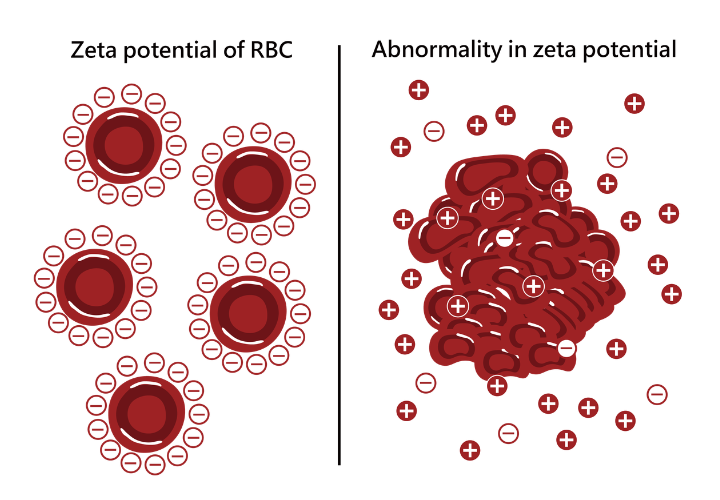
Scientists are studying how water behaves when it sits next to biological surfaces like proteins and cell membranes.
Exclusion Zone (EZ) Water – Laboratory experiments show that water near certain surfaces can form organized layers that push away particles. This is sometimes called exclusion zone water.
Researchers have observed this effect repeatedly in controlled experiments, although scientists are still studying how important it is inside the human body.
Important clarification:
Instead, the body appears to create structured water naturally through interactions between water and cellular structures.
Cells are packed with proteins and membranes — ideal environments for organized water layers to form.
Scientists propose that these water structures may help with:
Research in this area is ongoing, but one message is clear:
Water is not just something we drink — it is part of how every cell works.
Maintaining clean, high-quality hydration may help support these delicate biological processes.
Reverse osmosis is one of the most thoroughly studied water purification methods.
How It Works
RO systems push water through a very fine membrane that removes contaminants at the molecular level. Scientific studies show RO membranes effectively remove many dissolved substances through size filtering and chemical interactions.
Documented benefits include:
RO systems purify water — they do not add medications or special health substances.
Our favorite home RO system is AquaTru, which offers countertop, under-sink, freestanding, and shower filtration options without complex installation.
The system uses multiple filtration stages:
Together, these filters remove more than 80 contaminants, including:
Third-party testing reports removal rates such as:
This helps ensure cleaner water for drinking, cooking, and daily hydration.
Research continues to reveal how complex hydration really is.
Water is more than a beverage — it is the environment in which life happens. Studies show hydration affects inflammation, circulation, and cellular behavior at both chemical and physical levels.
One conclusion is clear: Water quality matters.
Choosing clean, purified water may be one of the simplest and most powerful steps you can take to support long-term wellness at home. Let us help you improve your hydration, your home, and your health. Schedule a Kickstart consultation today!

Dr. Jane Bowser is a certified health coach, nutritionist, and personal trainer, blending academic expertise with a passion for holistic wellness.